When the Past Still Feels Present: Exploring a More Compassionate Approach to Trauma Healing
Sometimes understanding what happened isn't the whole story. Discover how body-centered approaches, attachment science and neuroscience are opening new perspectives on emotional well-being, relationships and the experiences we carry with us.
Have you ever wondered why certain experiences seem to stay with you long after the moment has passed? Perhaps a difficult relationship continues to influence how you connect with others. Perhaps a loss changes the way you see the world. Or perhaps you understand your past intellectually, yet still find yourself returning to familiar emotional patterns.
These experiences are part of what makes healing such a deeply personal journey. Our memories, relationships, emotions and physical responses are interconnected, and exploring those connections can offer a different way of understanding ourselves.
This is one reason trauma-informed education, somatic practices and neuroscience have attracted growing interest among people seeking personal insight and professionals who support others.
Among the educational organizations exploring these subjects is The Embody Lab, which brings together teachers and practitioners from different disciplines to examine the connections between the body, the nervous system, relationships and emotional well-being.
Visit The Embody Lab to review the program details and current availability.
Somatic Attachment Therapy Certificate: Understanding the Patterns Behind Our Relationships
Why can closeness sometimes feel uncomfortable? Why might someone long for connection while finding it difficult to trust, receive support or maintain healthy boundaries?
Attachment offers one framework for exploring these questions. Our early relational experiences can influence what we expect from connection, how we respond to uncertainty and how we protect ourselves when relationships feel challenging.
The Somatic Attachment Therapy Certificate takes an integrative approach to these themes, bringing attachment theory into conversation with developmental trauma, neuroscience, body awareness and relational practices.
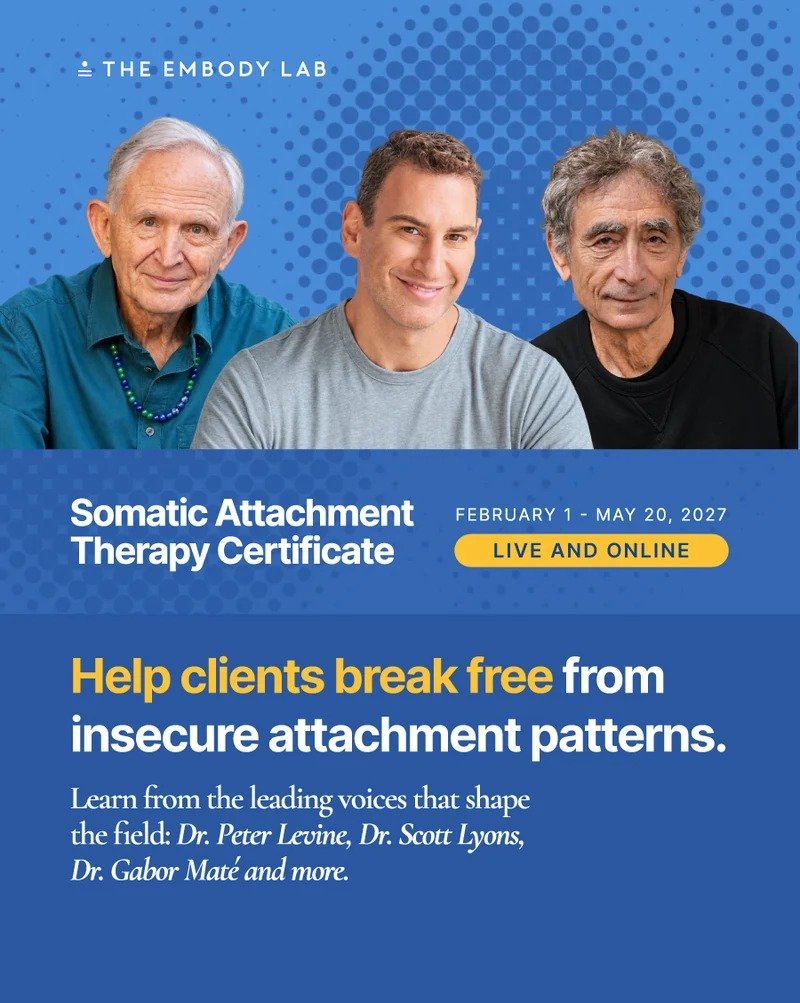
Learning from established voices in the field
One of the most compelling aspects of this program is its interdisciplinary faculty. The published program page features recognized teachers whose work spans trauma, attachment, developmental psychology and somatic approaches.
- Dr. Gabor Maté — known for his work exploring the connections between trauma, stress, emotional development and health.
- Dr. Peter Levine — known for developing Somatic Experiencing, a body-oriented approach to understanding and working with trauma.
- Dr. Dan Siegel — recognized for his work in interpersonal neurobiology and the development of the mind.
- Dr. Scott Lyons — works at the intersection of somatics, trauma, embodiment and nervous-system awareness.
- Kai Cheng Thom — brings perspectives on relationships, community, identity and healing.
The curriculum progresses from understanding attachment and relational wounds to exploring greater internal security, embodied awareness, boundaries, intimacy and the possibility of repairing ruptures in relationships.
What makes this approach particularly interesting is its emphasis on more than simply identifying a pattern. It also explores how that pattern may be expressed through bodily sensations, expectations, emotions and interactions with other people.
This certificate may be worth exploring if attachment and relationships are central to your personal interests or professional practice.
Integrative Grief Counseling Certificate: Making Space for Grief Without Rushing the Process
Grief doesn't always follow a predictable timeline. It can arise after the death of someone we love, the end of a relationship, a major life transition or the loss of a future we once imagined.
Although grief is a universal human experience, the way each person lives through it is unique. Sometimes people need space to express what they feel. At other times, they may be searching for meaning, connection or ways to navigate everyday life while carrying a significant loss.
The Integrative Grief Counseling Certificate approaches grief through a combination of applied neuroscience, somatic practices, therapeutic dialogue, ritual and relational understanding.
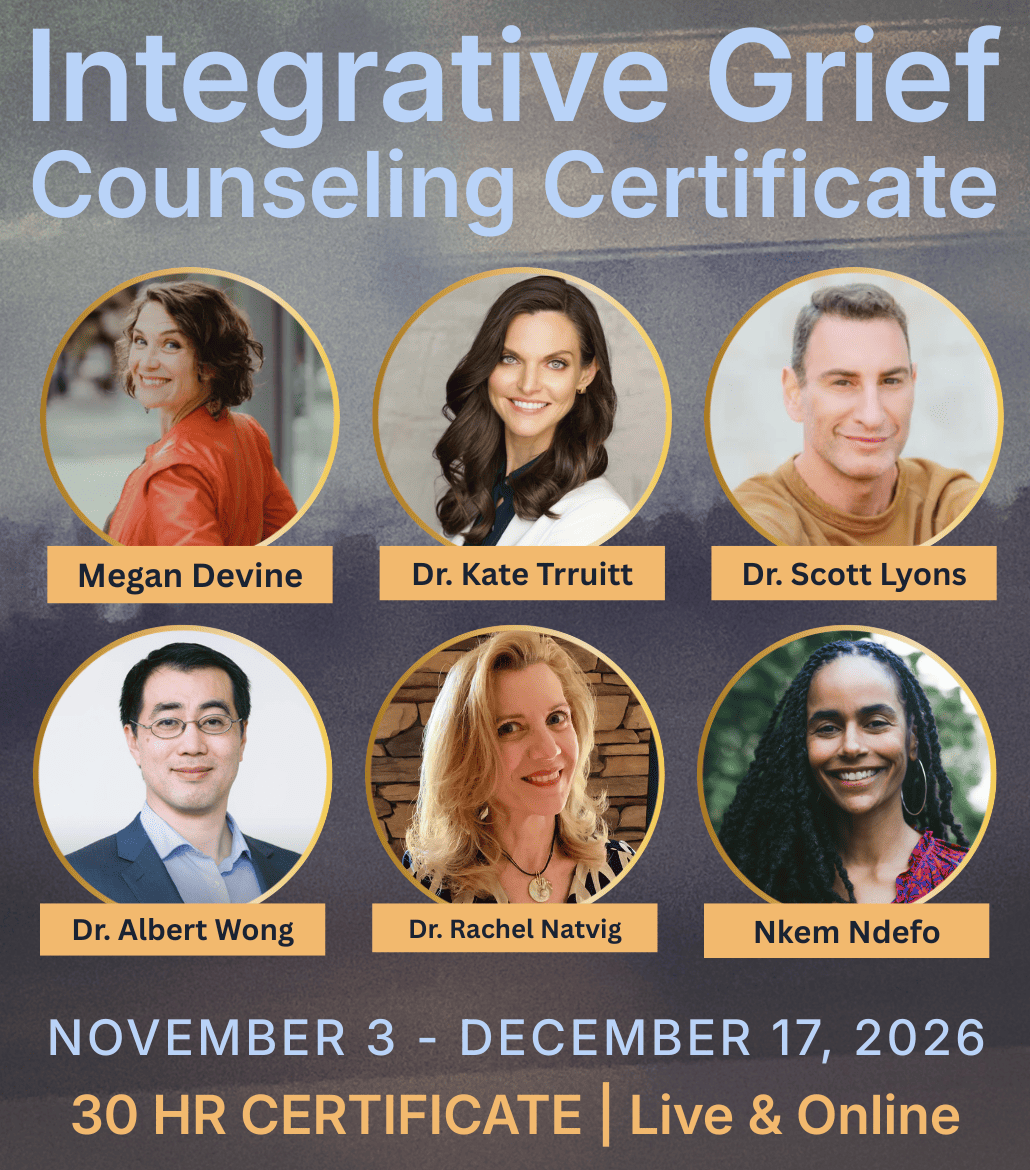
Six perspectives on grief and healing
The program brings together six faculty members whose different areas of expertise help illuminate the many dimensions of loss and grief.
- Megan Devine — known for her compassionate, grief-informed approach to living with loss.
- Dr. Kate Truitt — explores neuroscience, emotional resilience and trauma-informed approaches.
- Dr. Scott Lyons — brings somatic and embodiment perspectives to emotional well-being.
- Dr. Albert Wong — works in somatic psychology, embodiment and experiential learning.
- Dr. Rachel Natvig — contributes perspectives on grief and integrative therapeutic practice.
- Nkem Ndefo — known for somatic approaches to resilience and well-being, including the Resilience Toolkit.
The published curriculum moves beyond a purely theoretical discussion of grief. It explores how loss may be experienced in the body, how neuroscience can inform our understanding of emotional responses, and how practitioners can create space for expression, connection and meaning.
It also considers broader forms of grief, including collective and societal loss, and the importance of sustainable practices for those who support others through difficult experiences.
For counselors, therapists, coaches and other helping professionals, this certificate offers an opportunity to deepen their understanding of grief-related work. It may also interest people who want to explore the subject through a structured educational program.
The announced edition runs from November 3 to December 17, 2026. Check the official program page for current enrollment status and any subsequent editions.
Applied Neuroscience for Trauma Healing: Exploring What Happens Beneath the Surface
Trauma is often discussed in terms of memories and emotions, but the picture can be more complex. Sensory processing, attention, physiological responses and the way we interpret experiences can all be relevant to understanding how people respond to stress and adversity.
Applied neuroscience offers a framework for examining these connections. Combined with somatic and narrative approaches, it can help practitioners think more systematically about the different ways people experience and process difficult events.
The Applied Neuroscience for Trauma Healing Certificate brings these subjects together in a structured educational program designed to connect scientific concepts with experiential learning and clinical application.
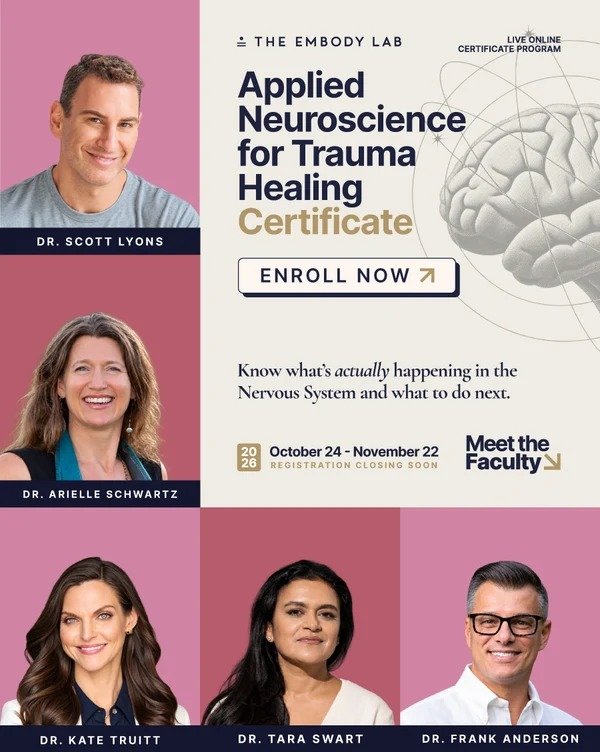
Meet the faculty connecting neuroscience and practice
- Dr. Arielle Schwartz — known for her work in trauma recovery, resilience and mind-body approaches.
- Dr. Kate Truitt — brings expertise in applied neuroscience, trauma and psychological resilience.
- Dr. Scott Lyons — explores somatic awareness, movement and nervous-system responses.
- Dr. Frank Anderson — known for integrating trauma treatment with neuroscience and Internal Family Systems-informed approaches.
- BG Mancini — contributes to the program's exploration of smell, taste and the brain-gut sensory axis.
The published program is organized into three progressive learning weekends. The first examines the traumatized brain, brain networks and memory. The second focuses on sensory systems and their relationship to perception and responses to the environment. The third brings together integrative somatics and applied neuroscience.
A notable feature is the attention given to the different sensory pathways, including touch, movement, interoception, hearing, vision, smell and taste. The curriculum also explores how practitioners may integrate body-oriented interventions with narrative processing and meaning-making.
Rather than presenting neuroscience as an abstract collection of concepts, the program aims to connect theory with practical frameworks that eligible professionals can explore in their work.
Please note that the published October–November 2026 edition is already underway as of this article's update. Visit the official program page to check whether a future edition or other enrollment option is available.
What Is The Embody Lab?
The Embody Lab is an online education platform focused on embodiment, somatics, trauma-informed learning and personal well-being. Its educational programs bring together teachers from a range of disciplines to explore how the body, mind, relationships and lived experiences intersect.
Rather than concentrating on a single school of thought, the platform offers training that draws on subjects such as neuroscience, attachment, movement, emotional awareness and relational practices.
Its stated mission is to make embodiment, somatics and trauma-healing education more accessible to a broad global audience, including individuals exploring their own development and professionals looking to expand their knowledge.
The three programs featured in this guide illustrate different aspects of that approach: attachment and relationships, grief and loss, and the neuroscience of trauma.
These are educational programs, not a substitute for individualized mental health care. A certificate of completion should not be interpreted as professional licensure.
Which program is worth exploring first?
The best starting point depends on the questions you want to explore and your professional or personal interests.
- For relationships and attachment: explore the Somatic Attachment Therapy Certificate.
- For grief and loss: consider the Integrative Grief Counseling Certificate.
- For neuroscience and sensory processing: explore the Applied Neuroscience for Trauma Healing Certificate and check the availability of future editions.
Each curriculum has its own emphasis, teaching team and schedule. Taking a closer look at the faculty, learning objectives and course structure is a useful way to decide whether a program aligns with your interests.
Learning Can Open the Door to New Perspectives
Exploring trauma, attachment and grief requires care, context and respect for each person's individual experience. No single course or method can promise the same outcome for everyone, but thoughtful education can introduce new frameworks, useful questions and different ways of understanding complex human experiences.
What stands out across these three programs is the effort to connect established fields of study with a more integrated view of the human experience—one that considers the body, the nervous system, personal history and relationships together.
If any of these subjects resonates with you, the next step is to review the official curriculum, meet the faculty and determine whether the program fits your goals.
Check the latest program information, dates and enrollment options directly with the provider.
About This Guide
This independent editorial guide was prepared using publicly available information about The Embody Lab and its published educational programs. Program details, faculty participation, schedules and availability may change. Please consult the official website for the most current information.
This article is intended for general educational and informational purposes. It does not provide medical advice, diagnose or treat a mental health condition, or guarantee a particular personal or professional outcome.
Affiliate Disclosure
This page contains affiliate links. If you choose to register for a program or make a purchase through a link on this page, we may receive a commission at no additional cost to you. This does not change the terms or pricing offered by the program provider.
Important Notice
This is an independent informational and editorial page. It is not the official The Embody Lab website, and it is not affiliated with or endorsed by The Embody Lab unless explicitly stated by the organization. The programs are provided by The Embody Lab. For the latest information about program dates, faculty, curriculum, registration, eligibility and terms, please refer to the official website.